Holding pattern is a maneuver required by the A/c to perform in the vicinity of an airfield, awaiting its turn to land.
It is used to positively maintain the traffic separation in terms of horizontal separation. The holding pattern is mainly used at big and busy airfields, where it is a standard practice for an A/c to perform few holds until cleared to descend to the circuit height and cleared for the approach, awaiting its turn to land. The minimum altitude that is maintained in the holding pattern should give a clearance of at least 1000 feet from the surrounding obstacles and is the minimum altitude on a holding pattern. The Minimum Holding Altitude (MHA) is given for every holding facility is given in the Jeppesen charts.
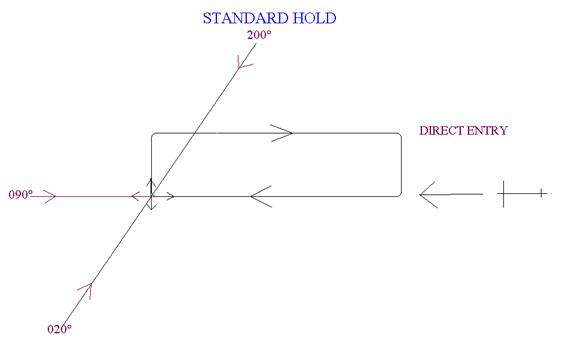
STANDARD HOLDING PATTERN – is the pattern where an A/c is required to make all turns towards right in the hold.
The holding pattern is calculated from the navigation facility.
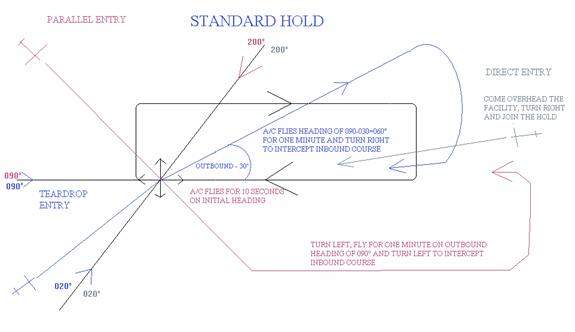
There are three types of entries that can be made to enter in the holding area, they are as follows-
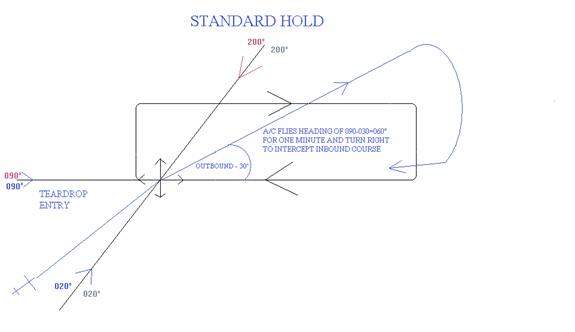
TearDrop Entry – is the entry that the A/c has to use when it is approaching from the opposite end of the holding area as shown in the diagram. The area of 70 degrees requires a teardrop entry to be made whenever A/c is approaching from this direction.
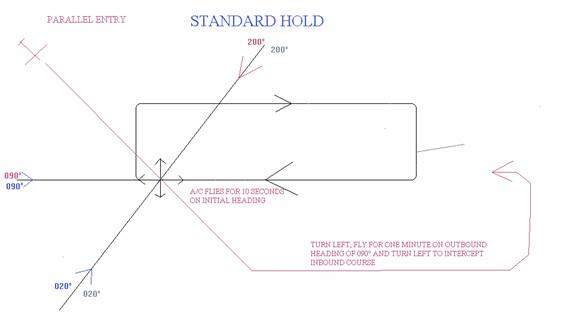
Parallel Entry– is the entry that the A/c has to use when it is approaching from the opposite end of the holding area as shown in the diagram. The area of 110 degrees requires a teardrop entry to be made whenever A/c is approaching from this direction.
Direct Entry – is the simplest of all the entries, it has a area of 180 degrees and A/c just has to fly straight to the facility and join the hold.
NON STANDARD HOLDING PATTERN– is the pattern where an A/c is required to make all turns towards left in the hold.
The holding pattern is calculated from the navigation facility.